I mentioned it in the Ronda post, but part of this Academic Travel involved learning about "corrida" and "el toro bravo", aka bullfighting. It was fascinating because it is such a complex part of Spanish culture that is really controversial, but after this travel I feel like I have a much better understanding of the situation. I could talk about Spanish bullfighting for hours!
Things you might not know about bullfighting:
1) The bull always dies in the end. The matador's final act is to kill the bull with a sword to the heart (preferably in one try). Somehow this simple fact always eluded me.
2) As part of the show, men on armored horses stab spears and barbed hooks into the bull to weaken it before the matador comes out into the ring. By the time the matador is on the scene the bull is already tired and bloody. Once again, I feel like I never saw this in the movies or other depictions of bull fighting? Anyone else??
3) Before killing the bull, the matador puts on a death-defying show by getting the bull to run past him, almost touching him, but not getting injured. The cape is used to try and direct the bulls path. It is all very styled and graceful, like a dance, some would say it is beautiful.
4) In Spain opinions are very split on the topic of corrida, some people cry with passion for it, others say it is barbaric. Barcelona's regional government Catalonia banned bullfighting in 2010, but the Spanish national government ruled their ban unconstitutional on the 5th of October this year.
Our second stop in "bull-fighting education", after the famous bull-fighting arena in Ronda, was to visit a ranch where the "brave bulls" live before their fateful day in the ring.
It was like the wild west of Spain.

Our brave cowboy who accompanied us on our tour ^ Everyone called him "shoe"

This was our tour guide ^ The rugged rancher Juan/John. I don't know if you can tell in the photo but he's a giant, like at least 6ft 3in and I'd bet he secretly wrestles with the bulls. He was very informative and despite being the owner of a bull ranch I found him to have a really fair take on corrida. He talked frankly about the animal welfare concerns, he explained how the whole system works, and he gave us his opinion on whether or not its around to stay (spoiler alert: he says yes).

Stampeding bulls (prompted by brave Cowboy Shoe). The bulls also run way faster than you'd think! Note to self: do not try and outrun a healthy bull.


^ more running bulls
And the gorgeous land where the bulls roam freely while they grow up. Compare this to the U.S. system of factory feedlots and livestock that never see the light of day. I'd say these bulls are pretty low on the list of animal rights concerns.

Other interesting things I learned:
The bulls are bred for aggression, but they have no interaction with humans before the fighting ring. They will occasionally fight within the herd, but mostly they live a peaceful life on the farm.
Why no human interaction? Because it's all part of the trick! Bull fighting depends on the bull being tricked into thinking that the cape is part of the man and by charging the cape he is attacking the man. But as soon as he figures out that they are two separate things the man has lost all advantage and will be dead in a heartbeat. This is why all bulls only fight in one match, why they are always killed in the end (instead of fighting multiple matadors) and why there are time limits in the ring. Because the longer the bull and the matador are in the ring dancing around each other, the higher the risk the bull figures it out and charges the body instead of the cape.
So, if there is no human interaction how do they figure out which bulls are the most aggressive to sell for a higher price to the arenas? They devised a plan straight out of a dystopian novel. They take the young bulls mothers and have the mother battle in a mock matador fight to test her level of aggression and how she responds to the matador. They then assume that her son will have a similar response.
Thankfully we did not watch a bullfight on this trip (it was not Corrida season) and the arena offered to have a matador fight a young bull for us, but our professor passed on that.

-----------
Our next stop: Córdoba
FAVE FAVE FAVE
Cordoba may be home to the most unique catholic cathedral I've ever seen and I've probably seen 100+ churches in my time at Franklin.. (Ok, its tied with Sagrada Familia, my other #1). This church is huge and currently a catholic cathedral, but it is housed in an old islamic grand mosque and the building has kept many of the original Islamic elements, with weird bursts of gothic/neogothic architecture.
It's like you can see the synthesis of Islam and Catholicism happening right inside the church.

Big heart eyes for that door.

Its name is La Mezquita-Catedral de Cordoba, or the Mosque-Cathedral of Cordoba. But everyone calls it la mezquita for short, even though it isn't actually functioning as a mosque at the moment.
This is actually a point of the contention in the community.
The local muslim population has asked many times for the church to consider allowing them to worship again in the church as a "shared space" arrangement, since the site has spiritual/historical significance to the muslims as well. But the local catholic leaders have consistently rejected the request. Our tour guide was hopeful that under the guidance of Pope Francis, and his rhetoric of interfaith community building, that muslims will once again be allowed to claim a bit of this church as their own sacred space.

The site has a long history and has changed hands many times!
It was originally a visgoth Christian temple that was built into a catholic basilica. Then when the Muslims conquered Spain in 711 they split it in half, one side for Christians, one for Muslims. The two religions shared the space until 784, when the muslim ruler bought the christian half, tore down the original structure and began construction on the grand mosque of Cordoba. The architecture of the grand mosque is much of what remains today. It took two centuries to fully finish building, but it blows my mind that so much of the architecture that is in these photos was constructed between 780-980, that's well over 1,000 years ago! And it's still standing! In fact, there was a corner of the church in which they found stones that builders engraved their names in, in arabic. I bet they never expected that someone 1,000 years in the future would be reading them.


just dying at how beautiful every corner is and the sun streaming through..


These columns are the focal point of one section of the church and seemed to go on forever! Historic texts compared them to local orange groves. Our guide pointed out that many of the columns have small differences in style because the architects of the mosque reused the Roman pillars that were used to construct the original church in the 4th and 5th century. So clever and adds an even additional layer of historical depth to the building!

And then woah, flash forward a few hundred years to a whole different form of architecture. It felt like stepping into a completely different church, but it really was just the catholic renovations to the mosque.


Beautiful, but in this context a real travesty and out of place. I think it looks garish in comparison with the intricate stone and wood geometric carvings of the Islamic architecture.
Then few photos from around Cordoba's city:

I had Les Miserables on the brain this trip (which is a story for another post). But this bridge ^^ totally reminded me of Javert jumping to his suicide, anyone else with me?

crsip white walls

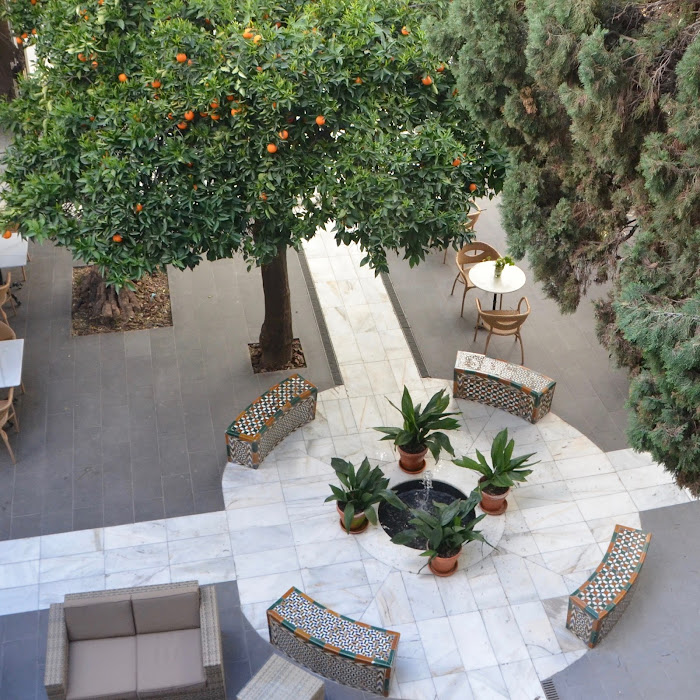
^ This was the wall of the inner courtyard of a historic home. Our tour guide explained that all the old homes in Cordoba were built around these inner courtyards which were designed to have some vegetation and the stones during the summer were splashed with cool water which acted like a swamp cooler to keep the whole house cool in the heat. I wish I had gotten a panorama of the courtyard. It was so lovely!
More Spanish treasures ahead! Next stop, one of the coolest places in Southern Spain, Alhambra a UNESCO World Heritage site in Grenada!
xx Jess